Algorithms
Algorithm TransAT schema Algorithm TransAT schema

TransAT© Single- & Multiphase Flow: Architecture & Structure

The CFD/CMFD code TransAT© developed at ASCOMP Switzerland is a multiscale, multi-physics, finite-volume code based on solving multi-fluid Navier-Stokes equations. The code uses structured meshes, though allowing for multiple blocks to be set together. MPI parallel based algorithm is used in connection with multi-blocking. The grid arrangement is collocated and can thus handle more easily curvilinear skewed grids. The solver is pressure based (Projection Type), corrected using the Karki-Patankar technique for low-Mach number compressible flows, up to Mach = 2.5. High-order time marching and convection schemes can be employed; up to third order Monotone schemes in space. The mesh generation can be achieved either using traditional Boundary Fitted Coordinates (BFC), with help of external meshing tools like GRIDGEN, or using the IST/BMR methods described next, for which the TransAT Suite has a specific grid generator: TransAT-MESH. Multiphase flows are tackled using interface tracking techniques for both laminar and turbulent flows, where the flow is supposed to evolve as one fluid having variable material properties, which vary according to the colour function. Specifically, the Level-Set approach, the phase-field variant and the Volume-of-Fluid methods can be employed. Static or dynamic angle treatment is also possible. Turbulent multiphase flows can be tackled within both the RANS and LES (and V-LES) frameworks, with specific interfacial treatments. This technique is very specific to TransAT, and is known as LEIS, short for Large Eddy & Interface Simulation. The main elements of TransAT architecture and structure are listed in the Tables below.


The Immersed Surfaces Technique (IST)

Immersed boundary (IB) techniques have been developed in the late 90s for flows interacting with solid boundary under various formulations (Mittal¬ & Iaccarino, 2005). The mostly known formulation for instance employs a mixture of Eulerian and Lagrangian variables, where the solid boundary is represented by discrete Lagrangian markers embedding in and exerting forces to the Eulerian fluid domain. The interactions between the markers and the fluid variables are linked by a simple discretized delta function. IB methods are all based on direct momentum forcing (penalty approach) on the Eulerian grid. The forcing should be performed such as it ensures the satisfaction of the no-slip boundary condition on the immersed boundary in the intermediate time step. This procedure thus involves solving a banded linear system of equations whose unknowns consist of the boundary forces on the Lagrangian markers; thus, the order of the unknowns is 1D lower than the fluid variables.

Representation of solid and fluid components using IST.

Fig. 1: Representation of solid and fluid components using IST.

The Immersed Surfaces Technology (IST) has been developed by ASCOMP GmbH (to the best of our knowledge), although other similar approaches have been developed in parallel. The underpinning idea is inspired from Interface Tracking techniques for two-phase flows (Level Sets), where free surfaces are described by a hyperbolic convection equation advecting the phase colour function. In the IST the solid is described as the second ‘phase’, with its own thermo-mechanical properties. The technique differs substantially from the Immersed Boundaries method of Peskin, in that the jump condition at the solid surface is implicitly accounted for, not via direct momentum forcing (using the penalty approach). It has the major advantage to solve conjugate heat transfer problems, in that conduction inside the body is directly linked to external fluid convection. The solid is first immersed into a cubical grid covered by a Cartesian mesh. The solid is defined by its external boundaries using the solid level set function. Like in fluid-fluid flows, this function represents a distance to the wall surface; is zero at the surface, negative in the fluid and positive in the solid. The treatment of viscous shear at the solid surfaces is handled very much the same way as in all CFD codes, where the wall normal vector needed to estimate the wall shear ( ) is obtained using: . The wall-normal vector is thus stored from the beginning in a specific array, used when required. The momentum and energy equations within the multi-component formulation (gas, liquid, solid) can simply be written under the form:

where the RHS source terms marked by Dirac functions in the momentum equation indicate the forces at the fluid-fluid interface (surface tension), and fluid(s)-wall force (wall shear), respeczively. The fluid(s) and the solid have their own material properties, based on the solid Level Set function: density, heat capacity, thermal conductivity and viscosity in the equations:

Block-Mesh Refinement (BMR)

The BMR technique was developed in the TransAT code to help better solve the boundary layer zone when use is made of the IST technique discussed above. In BMR, more refined sub-blocks are automatically generated around solid surfaces; with dimensions made dependent on the Reynolds number (based on the boundary layer thickness). An unlimited number of sub-blocks of various refinements can be generated, with connectivity between the blocks matching up to 1-to-8 cells. This method can save up to 75% grid cells in 3D, since it prevents clustering grids where unnecessary.

The combined IST/BMR technique has various major advantages over traditional methods; these are enumerated below (including ongoing developments):

  • Rapid gridding of complex geometries & set-up of flow boundary conditions
  • Suitable for moving bodies, fluid-structure interactions
  • Suitable for conjugate heat transfer
  • Retain high-order scheme accuracy (Cartesian grids)
  • No need to change discretization
  • Local Defect Correction (LDC) – fully conservative
  • Automated refinement per block: where needed
  • Scalable parallelization; save up to 70% cells in 3D

The Adaptive Mesh Refinement Technique (AMR)

Adaptive mesh refinement (AMR) as implemented in TransAT is used to refine grids dynamically around evolving fluid-fluid interfaces. The method is based on discretizing the continuous domain of interest into a grid of many individual elements of smaller size, automatically and dynamically clustered around moving interfaces. The general advantages of dynamic gridding schemes are: increased computational and storage savings, and complete control of grid resolution. In TransAT, AMR for interface tracking returns a better resolution for interface topology, for curvature determination, for contact angle treatment, and for mass conservation within the level set approach. The technique is available in 2D only; the full 3D version is expected for 2011.

The Sharp Solid Interface Treatment (SSIT)

The IST algorithm described in Section 1.2 may have drawback in some case, in that objects have to be resolved on the grid, using a minimum of 2-3 grid cells completely inside the solid to fully block the flow. If there are less cells inside the solid, the flow feels the presence of the solid only partially. To resolve this issue, the code TransAT has been recently upgraded using the so-called sharp solid interface formulation, which modifies the original IST algorithm by decoupling the equations at surfaces based on surface normal’s that are dependent on the solid level set function (gradients). With this, even an infinitely thin solid perceives the full blocking effect on the oncoming flow. The mathematical background of the approach is beyond the scope of this document; below we present a couple of illustrative examples.

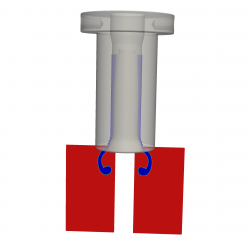
Fig. 2: IST based representation of a thin flat plane across flow. Resulting flow & pressure.

The first example shown in Fig.1 involves the 3D flow past a thin solid plate located in the cross flow. As shown in the grid, the resolution is rather coarse, but still with this the flow past the obstacle is well resolved, as displayed in Fig. 3.
The next practical example involves the flow past a ventilation issue, containing very thin plates. Results are shown in Fig. 4 below. The formulation is capable to treat such complicated situations, for which traditional grid generation technique will fail.

Fig. 3: Flow and pressure past the thin flat plane.

Fig. 3: Flow and pressure past the thin flat plane.

Numerical Schemes & Scalability

TransAT has the unique feature to run either in explicit or implicit, depending on the test problems considered, for both single and multiphase flows, depending on the turbulence models employed. In implicit solutions, the user can resort to steady state or transient time marching schemes; a pseudo-transient approach exists as well, used in particular for pollutant dispersion. TransAT uses high order schemes for convection and diffusion processes in the discretized transport equations.

Briefly, the schemes employed for convection in all equations are:

  • HLPA (2nd order)
  • CENTRAL (2nd order)
  • QUICK (3rd order)
  • SOUCUP (2nd order)
  • HYBRID & UPWIND (1st order)
  • TVD-based Schemes (2nd order)

The schemes employed for time marching are:

  • EULER (1st and 2nd order)
  • TLFI (2nd order)
  • TVD Runge-Kutta (2nd , 3rd and 4th order)

The schemes employed for re-distancing of level set equation are:

  • ENO (2nd order)
  • WENO (3rd order)
  • FAST MARCHING (1st & 2nd order)
  • NARROW BAND

The schemes employed for interface reconstruction & advection of VOF equation are:

  • PLIC (2nd order)
  • CVTNA (3rd order)

The schemes employed for compressible advection of density equation are:

  • UPWIND (1st & 2nd order)
  • CENTRAL (2nd order)
  • SMART (2nd order)

The schemes employed for pressure-velocity coupling are:

1.       SIP
2.       GMRES
3.       GMG & AMG
4.       PetsC Library

TransAT software is parallelized using Message Passing Interface (MPI) and domain decomposition methods. TransAT contains its own parallelized Elliptic solver based on the Strongly Implicit Procedure (SIP). It is augmented using the parallel PETSc solver library. The scaling analysis was performed for the merging of two bubbles (see e.g. Fig. 4) using 10 CPUs. The problem was simulated using level set method. The results in figure (5) below show a near linear scaling.

Fig. 4: Bubble merging test case.

Fig. 4: Bubble merging test case.

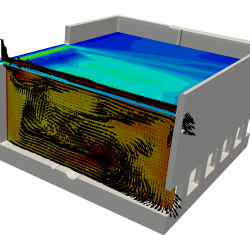
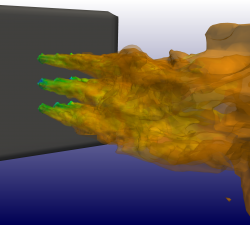
Another parallelization option implemented in TransAT is the OpenMP protocol, useful for Desktop shared-memory machines. The parallelization is operated at the Do-Loop level, where no domain decomposition is needed. This works for dual and quadcore CPU solutions, and takes advantage of the high level of vectorization of the code; i.e. 98%. Sensitivity studies have shown that the code outperforms for problems executed on 8 core machines, sometimes upgraded to 12 cores depending on the problem. The second test problems relates to the stratified air-liquid flow in an upslope pipe (45 deg.), simulated in 3D on INTEL supercomputer – with whom ASCOMP collaborates-, using a 2-million cell grid. The solution is shown in Fig. 6, where the interface of the slug is clearly depicted, interacting with the flow.

Fig. 5: Speedup and parallel efficiency analysis of the bubble merging test case.

Fig. 5: Speedup and parallel efficiency analysis of the bubble merging test case.

Fig. 6: Flow solution obtained with level set and VLES.

Fig. 6: Flow solution obtained with level set and VLES.

The results of the scaling are shown in Fig. 7. Deviations from the super-linear scaling are observed starting with 128 cores only; negative scaling appeared at 192 cores. Better scaling are obtained for problems treated using IST/BMR methods. The collaboration with INTEL is underway to find the best compilation and execution parameters.

Fig. 7: Speedup and parallel efficiency analysis of the upslope test case.

Fig. 7: Speedup and parallel efficiency analysis of the upslope test case.

Interface Tracking Schemes

VOF

In the VOF context, TransAT solves for the evolution of the liquid volume-fraction, identifying flow regions containing pure liquid from pure gas flow regions. The VOF method does not amount solely to the solution of this evolution equation, it requires accurate algorithms for advecting the volume fraction function so as to preserve conservation of mass. Since this cannot be achieved by means of conventional finite-difference schemes because of numerical diffusion, the VOF field are first advected, after which the interface location is geometrically reconstructed using these rough data. The 2D & 3D VOF technique implemented in TransAT features two variants of unsplit advection, together with the multidimensional flux calculation using cell-face velocities assigned to cell-vertices (Piecewise-Constant Flux Surface Calculation, or PCFSC). The evolution of the interface and advection of the phase-indicator function is accomplished by reconstructing the interface within each computational cell and computing the volume flux that occurs from each cell to its immediate neighbours under the prevailing flow. Use is made of the CVTNA high-order scheme of Liovic et al. (2006, Comp. & Fluids) is used for interface reconstruction. VOF is generally used for small-scale topology fragmentation, like sprays; but it remains expensive in terms of CPU.

Level Set

The level set approach consists in solving a hyperbolic equation to track the interface on a fixed Eulerian grid, using a smooth signed-distance function referring to the shortest distance to the front. Negative values correspond to one of the fluids and positive values to the other. The exact location of the interface corresponds to the zero level. Material properties like density, viscosity and thermal conductivity are updated in time using this distance function. The advantage of the method is that it dispenses with interface reconstruction employed in VOF, it can handle merging and fragmentation and it permits identification of the exact location of the interface, which helps treat interfacial physics (e.g. interfacial turbulence decay, interphase mass exchange). Our Level Set method works on both Cartesian and skewed curvilinear grids (BFC). It is accurate in that it uses 3rd to 5th order WENO scheme for space update and 3rd and 4th order Runge-Kutta for time marching. It uses various re-distancing schemes, including fast marching for BFC grids, conserving thus mass up to 0.1% mass loss. For practical problems, use is made of the global conservation scheme of Lakehal et al. (2002, IJHFF).

Phase Field

The Phase Field method is applicable to solving microscale flows involving two-phase complex fluid flows. An order parameter exists that provides a measure of the two phases. The order parameter can be the relative mass density or the concentration difference, or even a colour function that distinguishes the phases. The phases are separated by an interfacial region, called the diffuse interface thickness, where the order parameter changes rapidly, but smoothly. In the present formulation, the order parameter is an independent thermodynamic variable on which the free energy of the system is based.  The Phase Field method solves the convective Cahn-Hilliard equation and the Navier-Stokes equation is modified by the addition of a continuum forcing term (stresses, sometimes called Kortoweg stresses), which replaces the sharp-interface surface tension term by a diffuse interface. On comparison with the Level-Set method, Phase Field requires a larger number of computational grid points in order to capture the diffuse interface.  These factors make the method slower than the level-set method. The presence of the diffuse interface means that the spurious currents which develop in the surface tension formulation are virtually non-existent. These parasitic currents can destroy the solution in the sharp-interface limit in low-velocity cases where they drive the flow instead of the actual fluid velocity.

Advanced Turbulence Schemes/Approaches

LES

The limits of the RANS approach for both single phase and multi-phase flow (in particular) have been reached. The fierce competition between industrial key players in automotive and land-based and aerospace technologies in particular is promoting the development of new modelling strategies that put flow unsteadiness at the forefront of their predictive capabilities. This is the way ASCOMP has decided to go: to build an added-value modelling strategy based on LES, in complement of RANS. This observation applies in particular to industries in which reactive and multi-phase flow control the design. Many other industries are in search for similar new developments, too, namely oil & gas, thermal hydraulics of nuclear reactors and chemical and process engineering. This added to the constant growth of computer resources in terms of speed and storage helps replace the LES concept at the front stage of applied CFD. The LES strategy built in TransAT is very stable and highly accurate. It follows the guidelines of top literature, be it in terms of wall modelling, grid refinement, unsteady inflow boundary conditions (using synthetic models), numerical schemes. Our LES works for both explicit (CFL ~0.1) and implicit schemes (CFL up to 1).

V-LES

The Very Large-Eddy Simulation approach represents an excellent compromise between efficiency and precision as to capturing unsteady turbulence, and may thus be used for industrial problems for which LES remains computationally expensive. This is particularly true of high-Reynolds number flow conditions. It can also be used for gas-liquid two-phase flows such as pressurized thermal shocks. The method is a sort of blend between U-RANS and LES, in that it resolves very large structures – way larger than the grid size – and models all subscale of turbulence using a two-equation model, by reference to RANS. This model or rather modelling approach is proved to provide the flow unsteadiness in three-dimensions, while saving computational cost compared to LES. The method is computationally efficient (it can be applied using an implicit solver which permits a higher CFL than with LES; 0.1 vs. 1), and numerically robust. The computational cost decreases with increasing filter width, which in contrast to LES is not dependent on the grid size, but based on the characteristics length of the flow.

LEIS

In TransAT we have borrowed the LES strategy from single phase flows and coupled it with both VOF and Level Sets (presented above) for small-to-mild Reynolds number gas-liquid flows. The combination (referred to as LEIS; short for Large Eddy & Interface Simulation; see Lakehal, 2010, Nucl. Eng. Design) could lead to the simulation of the large-scale physics of interfacial flows down to the grid-resolved level. The idea consists of grid-filtering each phase separately; the resulting sub-grid scale (SGS) stresses are modelled as if they were isolated. Special treatment is necessary at the interface though, taking advantage of the fact that the lighter phase perceives the interfaces like deformable walls. The combination of the two approaches brings a notable difference, that is: besides delivering time-dependent interfacial kinematics (and provided the method could achieve sufficient resolution for the boundary layers at the interfaces), the need to model the interfacial exchange terms in the two-fluid phase conservation equations is eliminated. For the time being this is limited to interfacial flows with moderate topology fragmentation. A rigorous near-interface treatment is included, taking into account the interfacial shear on both sides of the interface (Liovic & Lakehal, 2007, JCP).

About us