28thSHORT COURSES
ZURICH
Modelling and Computation of Multiphase Flows:
Part I: Bases
Part IIA: New Reactor Systems and Methods
or
Part IIB: Computational Multi-Fluid Dynamics
(CMFD)
Part III: CMFD with Commercial Codes
Zurich, 14-18 February 2011
Hosted by the
Swiss Federal Institute of Technology(ETH)
in Zurich, Switzerland
THE COURSES
Multiphase flows and heat transfer with phase change are of interest to researchers, scientists and engineers working
in power, nuclear, chemical-process, oil-and-gas, cryogenic, space, food,
bio-medical, micro-technology, and other industries. Courses similar to this
one have been offered in the past at Stanford University, the University of California-Santa Barbara and elsewhere.
These courses have taken place annually at ETH-Zurich since 1984 with some 1700
participants so far. Over the years, the courses have continuously evolved,
reflecting on-going progress, interests, and developments; the number of lecturers has
gradually increased and parallel sessions were introduced in 1989. The Zurich courses not only offer the opportunity to meet and interact
with outstanding lecturers, but also with colleagues working worldwide on similar topics but in different industries.
The courses are organized in modules as intensive introductory courses for persons having basic knowledge of
thermodynamics, fluid mechanics, heat transfer, and numerical techniques, but also serve as
advanced courses for specialists wishing to obtain the latest information in certain areas.
Part I, Bases, covers the common background material and emphasises the latest modelling and
computational aspects of multiphase flows. A tutorial text is e-mailed to the participants before the course to
introduce the very basic concepts for this module and fill any basic gaps in their background,
to help them participate in the courses the best possible way.
Part IIA, New Reactor Systems and Methods, covers multiphase flow topics of particular interest
to nuclear engineers. This module reviews some of the most recently proposed
advanced reactor designs (including reactors considered for near-term
construction and those in Generation IV) and the main multiphase phenomena
of importance in these designs. This module also introduces the
state-of-the-art and beyond in modelling and simulation methods (including CFD and CMFD applications) for core design
and accident analysis. An article introducing reactors, and in particular Light Water Reactors, will be e-mailed as tutorial material
for non-nuclear specialists to the participants of this module before the course.
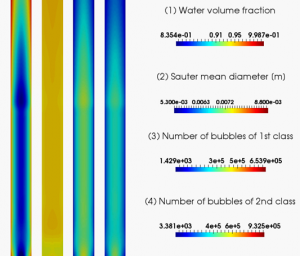
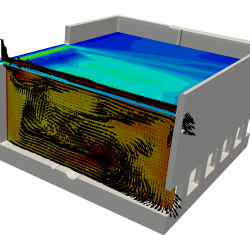
Part IIB, Computational Multi-Fluid Dynamics (CMFD), reflects the growing interest in
the application of CFD techniques to multi-phase flows; it is
continuously updated to cover the most common new computational techniques. The
introductory chapters from a book authored by Tryggvason, Scardovelli and Zaleski
will be emailed to the participants in Part IIB to prepare them for the lectures. Part III,
CMFD with Commercial Codes, is attached to both Parts IIA and IIB. The
participants will have the possibility to meet commercial code developers and
discuss their products for both nuclear and other applications.
The emphasis in these courses is on:
·
A condensed, critical and updated view of basic knowledge and future
developments, in relation to systems and phenomena encountered in industrial applications
·
Trends in modelling, design, analysis, computational techniques, CFD / CMFD methods and experimentation ·
Sources of information, data and correlations ·
Availability as well as limitations of modern modelling and computational techniques and codes ·
Interdisciplinary transfer of knowledge from one area of applications to another
These limited-enrolment courses feature:
·
A program of co-ordinated, 90-min lectures by experts in the field ·
A complete and extensive set of the lecture notes and other non-copyrighted course materials on a CD-ROM ·
Tutorial, introductory texts for all parts of the course emailed to the participants before the course ·
Handout-format hard bound copies of all the standardized PowerPoint presentations for use in the
classroom (it is not advised to bring laptops) ·
Movies, videos, animations, and computer simulations illustrating the physical phenomena and
the numerical techniques (with non-copyrighted material included in the CD-ROM) ·
Discussion time and discussions with the lecturers during and between lectures COURSE FEES AND REGISTRATION
All parts (either IIA or IIB) taken together: EUR 1500
Part I alone: EUR 1100
Parts IIA+III or IIB+III alone: EUR 850 The fees include the
cost of course materials but do not include meals and hotel
accommodations. (A fee of EUR 100 will be retained in case of cancellation after
February
4, 2011.) Please download and fill out the
Registration Form
The course organizers
reserve the right to cancel the course on short-term notice, with full refund of
the fees, in case of force majeure, travel restrictions, non-availability of the venue,
forced absence of several lecturers, etc.
HOTEL ACCOMMODATIONS You may fill out the
Hotel Registration form
(pdf) and mail or fax to CBS (not to the Course address)
Information for other numerous hotels in the city of Zurich,
in all categories, is also available at the preceding link and from various other web sites. IMPORTANT ADDITIONAL INFORMATION
Click here for Schedule of Lectures and important additional practical
information. Click
here to download the course brochure.